Ingredients
For 12 modaks — serves 4–6 people as prasad. Scale up using the Modak Calculator. Tap any ingredient to tick it off.
Method
Read all 7 steps before starting. The filling must be made and cooled before you make the dough — both must be ready at the right moment.
Make the filling first
In a heavy-bottomed pan on medium heat, combine the grated jaggery with 2 tablespoons of water. Stir until the jaggery completely melts — about 3 minutes. Add the grated coconut and mix well. Cook, stirring continuously, until the mixture thickens and leaves the sides of the pan cleanly. This takes 7–8 minutes.
Add spices and cool completely
Remove from heat. Add cardamom powder, nutmeg, and poppy seeds if using. Mix thoroughly. Set aside to cool completely to room temperature. Do not skip this — hot filling will melt the dough and make shaping impossible.
Make the rice flour dough
Bring 250ml water to a rolling boil with salt and half a teaspoon of ghee. Remove from heat immediately. Add all the rice flour at once and mix vigorously with a wooden spoon until it forms a rough dough. Cover with a lid and rest for exactly 5 minutes.
Knead while still warm
When the dough is cool enough to handle (still warm, not hot), grease your palms generously with ghee. Knead for 2–3 minutes until the dough is completely smooth, with no cracks at the edges. If cracks appear, add warm water one teaspoon at a time and knead again. Keep covered with a damp cloth at all times — the dough dries out quickly.
Shape the modaks
Take a lime-sized ball of dough (about 30g). Grease your palm generously with ghee. Press the ball into a disc approximately 3 inches across — thinner at the edges than the centre. Place a tablespoon of filling in the centre. Bring the edges up and pinch into 4–5 pleats, then bring all the pleats together to a point at the top.
Steam for 10–12 minutes
Line a steamer with a banana leaf or lightly greased muslin cloth. Place the modaks with enough space between each — they should not touch. Steam on medium-high heat for exactly 10–12 minutes. They are ready when the shell turns slightly translucent and the surface feels firm but still soft to the touch.
Rest, then offer to Ganesha
Allow to cool for 5 minutes before handling — they firm up and become easier to move. Drizzle with a small amount of ghee before serving for the traditional sheen. Best eaten on the same day. Traditionally offered to Lord Ganesha first, then distributed as prasad to all present.

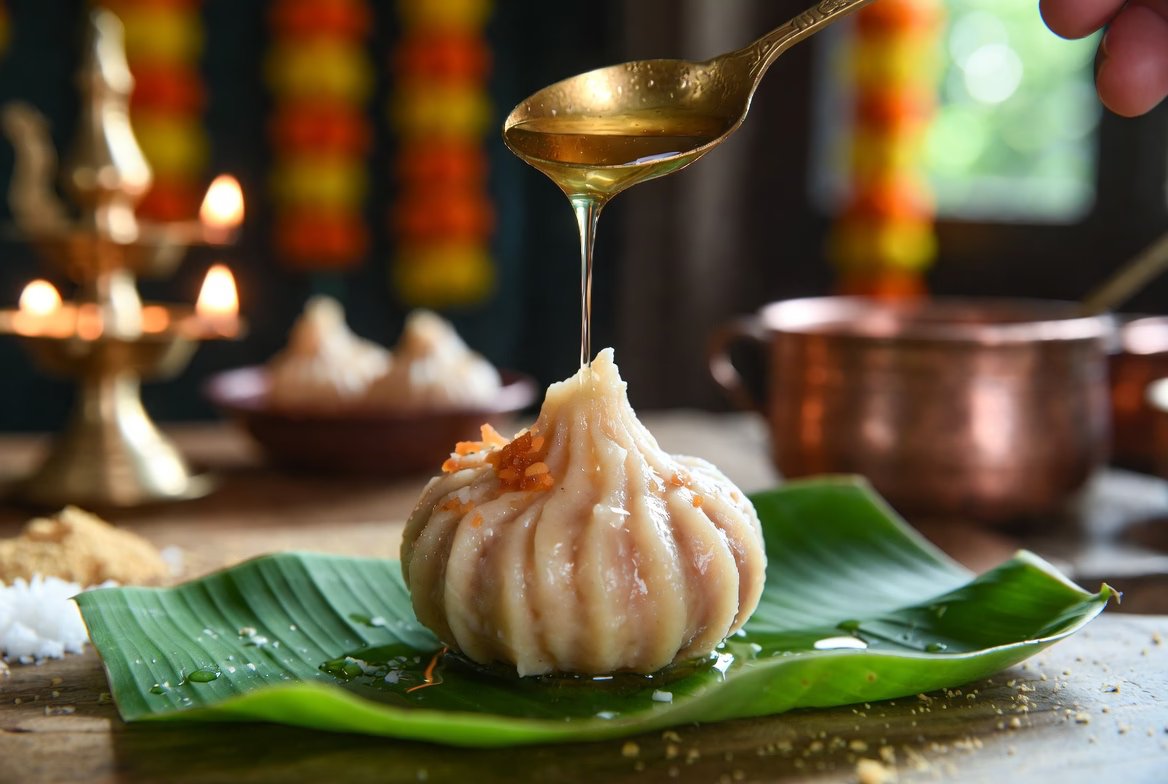
Gathering the pleats into the pointed top — the most satisfying moment in making ukadiche modak by hand
Tips & Troubleshooting
Every problem that can happen with ukadiche modak, and exactly how to fix it.
The dough is too dry. Add warm water one teaspoon at a time and knead until smooth. Also check your hands are well greased with ghee — the fat prevents the dough from sticking to your palms and allows smooth shaping.
Two possible causes: the filling is too wet (cook it longer until it holds shape without any moisture seeping out) or the shell is too thin at the base. When shaping, press the base slightly thicker than the sides.
Over-steamed. 10–12 minutes is the maximum. After 12 minutes the shell protein continues to tighten. Check at 10 minutes — the shell should be just slightly translucent and firm but soft.
Block jaggery is strongly preferred — powder often contains additives and doesn't melt as cleanly. If using powder, reduce the quantity by 10–15% and taste the filling as you cook it. The colour of the filling should be a deep caramel-brown.
Use desiccated coconut — ¾ cup for every 1 cup fresh. Add 2–3 tablespoons of warm water to the filling during cooking to compensate for the missing moisture. The result is slightly drier but the flavour is very acceptable. This is the most common substitution for the diaspora outside India.
About Ukadiche Modak
Ukadiche modak is the most important sweet in Maharashtra's culinary tradition — and arguably in all of Indian sacred cooking. The name translates simply as "steamed modak" (ukadiche meaning steamed in Marathi, modak from Sanskrit meaning that which gives happiness). But its significance goes far beyond its name.
This is the sweet that appears in the Ganesh Purana and Mudgala Purana as Ganesha's favourite offering — the sweet his mother Parvati made for him. It is the only food that appears in iconographic representations of Ganesha across every Indian tradition, held in his lower right hand as a symbol of the bliss he offers to devotees.
For Ganesh Chaturthi, the traditional offering is 21 ukadiche modaks — Ganesha's sacred number. On the 10th day (Anant Chaturdashi, the farewell), another 21 are offered before the visarjan. Many Maharashtra households have been making the same recipe, in the same sequence, on the same day, for generations. See the 10-day festival calendar →