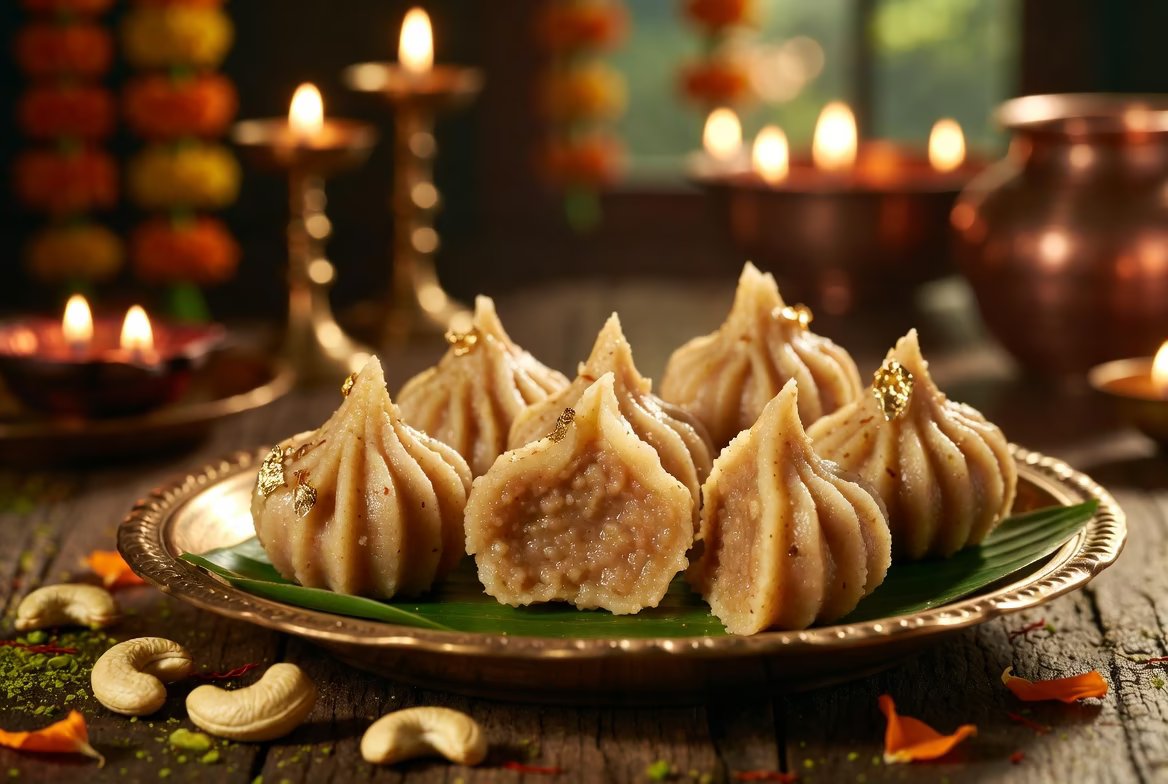
Ingredients
Makes 15 modaks. Scale using the Modak Calculator. Tap any ingredient to tick it off.
Method
Grind the cashews
Blend raw cashews in a food processor for 30–60 seconds into a fine powder. Do not over-blend — stop before the nuts release their oil and become cashew butter. The powder should be dry and fine.
Make the sugar syrup
In a small pan, combine icing sugar with 3 tbsp water. Heat on medium, stirring until sugar dissolves completely and the syrup reaches one-string consistency — test by touching a drop between thumb and forefinger: it should form a single thread.
Combine and knead
Add cashew powder to the hot syrup off the heat. Add cardamom and rose water. Mix vigorously until it comes together into a smooth dough. If too dry, add warm milk a teaspoon at a time. If too sticky, cool in the fridge for 5 minutes.
Shape while warm
Take 20g portions. Roll smooth, then press into greased modak mould and unmould. Or shape by hand — roll into a ball, then pinch the top into a peak, smoothing the sides with your fingers. Kaju dough is very forgiving.
Garnish and rest
Press 2–3 saffron strands onto each modak or add a small pistachio on top. Rest at room temperature for 30 minutes to firm up. The surface develops a light sheen as it sits.
Tips & Variations
Syrup was too thin or cashews were too dry. Add warm milk one teaspoon at a time and knead until it comes together. A little ghee also helps bind.
Syrup was too thick or the mixture got warm. Refrigerate for 10 minutes and knead again. Lightly oiled hands make shaping much easier.
Replace ghee with coconut oil and milk with water or coconut water. Rose water binding works without any dairy. Kaju modak is one of the most naturally vegan-adaptable modak varieties.
Kaju modak lasts 5–7 days at room temperature (cool, dry place) or 10 days refrigerated. For gifting, box in a single layer with parchment between layers. The ivory colour and clean shape look beautiful in a gold box.
About This Recipe
Kaju modak traces its lineage directly to kaju katli — the cashew sweet that is, alongside modak, the most gifted Indian sweet during festivals. The step from kaju katli to kaju modak is logical: the same cashew paste, shaped into the sacred form rather than cut into diamonds.
The result is a modak that occupies an interesting space — it looks like a traditional offering, shaped with the same reverence as ukadiche, but tastes entirely different. The cashew sweetness is subtle and clean, the cardamom fragrant, and the texture — smooth, dense, just slightly grainy on the tongue — is satisfying in a way that coconut-jaggery modak is not.
For gifting, kaju modak is the first choice. It travels well, lasts longer than steamed versions, looks beautiful, and is universally liked. A box of twelve kaju modaks with silver vark, presented in a gold box for Ganesh Chaturthi, is one of the finest festival gifts in the Indian sweet tradition.