Ingredients
Makes 15 modaks. Scale using the Modak Calculator. Tap any ingredient to tick it off.
Method
Crumble the khoya
Break the khoya into small pieces and place in a heavy pan. If using fresh market khoya it may already be crumbly. If using packaged khoya, grate it.
Cook gently
On very low heat, stir the khoya continuously for 8–10 minutes until it becomes soft, pliable, and starts to leave the sides of the pan. Do not let it brown. Remove from heat as soon as it comes together into a soft mass.
Add sugar and saffron
Off the heat, add sifted powdered sugar, cardamom powder, saffron milk, and rose water. Knead gently with your hands (lightly greased with ghee) until everything is incorporated and the mixture is smooth. Cool slightly until handleable.
Shape while warm
Take a portion of khoya (about 30g). Roll into a smooth ball. Press it into a greased modak mould, filling both halves completely. Close firmly and unmould. Or shape by hand: form into a teardrop by pressing and pinching gently — mawa is forgiving and re-shapeable.
Garnish and set
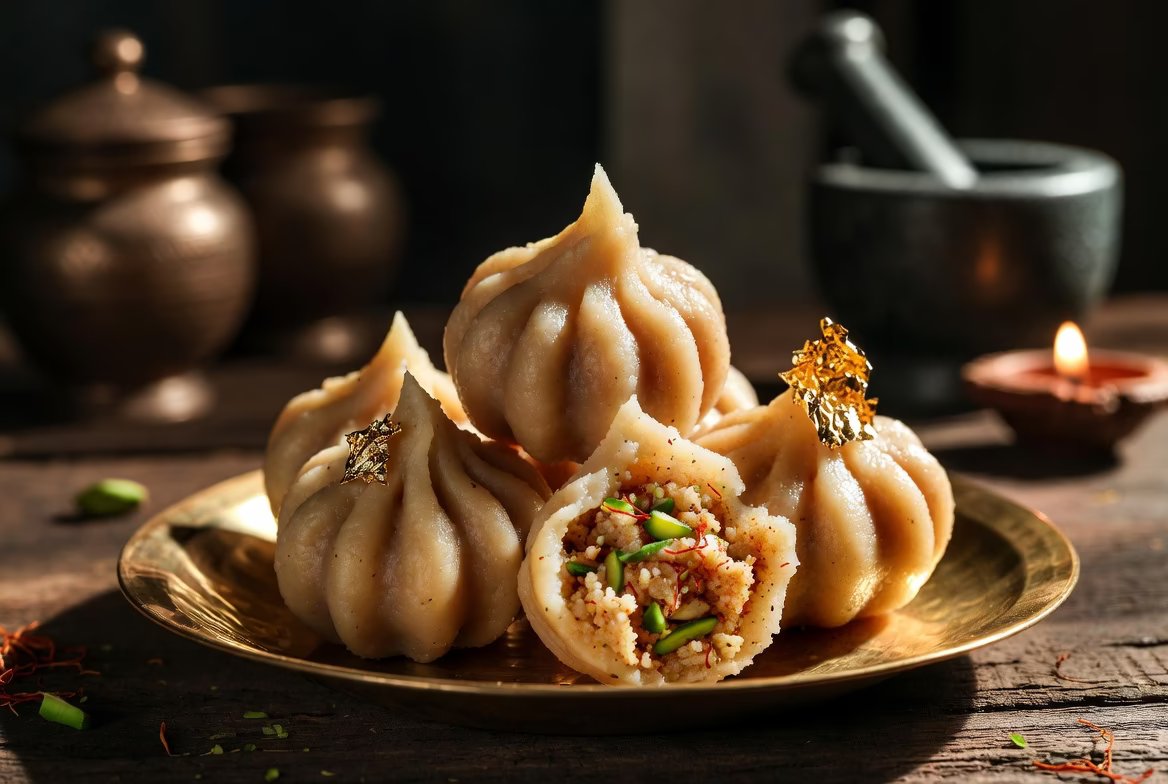
Press a small pinch of chopped pistachio into the top of each modak. If using silver vark, press a small piece onto the surface. Refrigerate for 30 minutes to firm up before serving or offering.
Tips & Variations
Too much moisture or sugar added while too hot. Refrigerate for 10 minutes, then knead again with lightly oiled hands. It will come together.
Khoya was overcooked or too dry to start with. Add 1–2 tsp warm milk and knead again gently.
Yes — use 200g condensed milk + 200g milk powder kneaded together as a substitute for khoya. The texture is slightly different but the result is good and the method is even simpler. No cooking required.
Refrigerate in an airtight container for up to 5 days. Best at room temperature — remove from fridge 20 minutes before serving. The flavour opens up as it warms.
About This Recipe
Mawa modak belongs to the great North and Central Indian mithai tradition — the milk-solid sweets that anchor every festive occasion. In Maharashtra, the term mawa and khoya are used interchangeably; both refer to milk that has been simmered until nearly all the water has evaporated, leaving behind a dense, rich solid.
The result in modak form is something quite different from the steamed original — denser, richer, more immediately satisfying. Where ukadiche modak is delicate and almost spiritual in its lightness, mawa modak is celebratory, indulgent, the modak you make when you want to show that no effort was spared.
Saffron is the non-negotiable addition. It gives mawa modak its colour — a pale golden-ivory — and its fragrance, which deepens over the day as the modaks sit. A mawa modak made with good saffron on the evening before the festival, refrigerated overnight, and served at room temperature the next morning is one of the great pleasures of the Indian festive kitchen.